en(able)+(in)cludo
The name says
what the product does.
Encludo is two words — Enable and Include — pushed together on purpose. The web should work for everyone, not just the people it was originally designed for. This page is how we got here, who we built it with, and what we’re not willing to compromise on.
Our story
We’re not here to check a compliance box.
Encludo started with a conversation, not a codebase. We’d spent years watching accessibility get treated as an afterthought — a last-minute scramble before an audit, a badge on the footer, an “overlay widget” that promised a fix and delivered lawsuits.
So we asked a different question: what would accessibility look like if you built it with the people who need it instead of for them?
The answer wasn’t another audit tool. It was a layer — a thin, one-script-tag layer — that puts the controls back in the hands of the person actually using the site. Larger text. Calmer colours. A font that doesn’t fight dyslexia. A simplified version of that dense pricing page. A translation into their first language.
Every feature is tested by people using their own assistive technology before it ships — screen readers, magnification, switch access, voice control. If it does not work for them, it does not ship. That is not a marketing line; it is the QA pipeline.
“Accessibility isn’t something you retrofit. It’s something you build with the people who need it, from the beginning.”

What we won’t compromise on
Four principles, no exceptions.
Built with the community
Every feature is tested by people who live with a disability before shipping. No synthetic personas, no AI-generated testers, no consulting firms speaking on behalf of disabled users. Real people, real workflows, real feedback.
Transparent by default
Every accessibility action is visible in your dashboard — which features your users activate, which pages need attention, how compliance trends over time. No black box, no guessing. The data is yours to export any time.
Privacy-first by design
Zero analytics by default. Opt-in functional mode sends a pageview counter and nothing else. Opt-in analytics captures feature usage at aggregate level — no PII, no fingerprinting, no cookies. GDPR / CCPA ready out of the box.
No overlay theatre
We don't promise "instant WCAG compliance" with an AI button, because that promise doesn't survive a plaintiff's lawyer. We hand real control to your visitors, report what still needs fixing, and are honest that the parts needing human judgement need a human.
How we think about it
Accessibility isn’t added later. It’s built in.
Most sites treat accessibility as a layer applied at the end — a badge, an overlay, a scramble before an audit. We think of it as part of the stack, sitting on top of your code and components rather than patching over them.
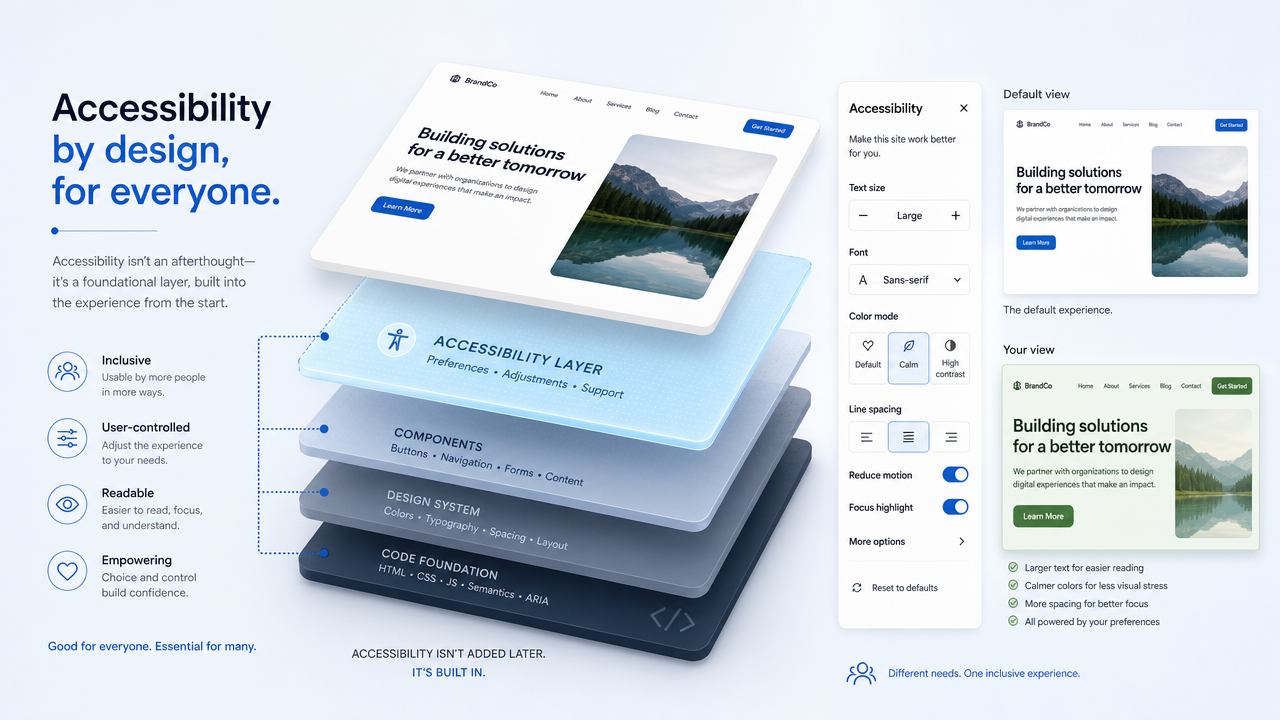
Inclusive
Usable by more people, in more ways — not a separate accessible version kept in a corner.
User-controlled
The person reading the page decides what they need. Nothing is guessed on their behalf.
Readable
Easier to read, focus on and understand — type, spacing, contrast and motion, all adjustable.
Empowering
Choice and control build confidence. Good for everyone; essential for many.
We’re here to make the internet
actually inclusive.
Not check a compliance box. Not collect dust on an audit PDF. Real tools, shipped with the community, on every page of your site.